
RoHS Without Exemptions: It’s Getting Serious
KOA is preparing for the probable expiration of RoHS 2 Directive exemptions by mid-2027. Accordingly, numerous thick-film resistor series must be offered in a lead-free version in a timely manner.
RoHS and Lead Content: Why Resistors Are Particularly Affected
Exemption 7(c)-I of the 2011 RoHS 2 Directive allowed manufacturers of electronic components, such as resistors, to use lead-containing compounds in their components. They did not have to adhere to the maximum limit of 0.1% by weight specified in the directive. This exemption has now been extended by the European Commission until June 30, 2027.
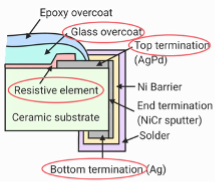
Lead is found in resistors, particularly in the form of leaded glass, where lead is incorporated into the glass as lead oxide (PbO). The cross-section illustrates the areas of a KOA SMD resistor where leaded glass is located.
These areas include (outlined in red) the upper and lower terminations, the glass coating, and the actual resistive element. In thick-film resistors, this largely consists of ruthenium oxide (RuO2) and precisely these lead-containing glass particles.
Replacing the lead oxide contained in the glass within the resistive layer poses particular challenges for manufacturers, as the glass particles within it significantly influence the electrical behavior of the resistor.
When manufacturers speak of “lead-free” or “total lead-free,” this must be somewhat qualified. As already mentioned, a lead content of max. 0.1% by weight is still permitted even after the exemptions expire. KOA will fall below this upper limit, but it is production-technically unlikely that not a single lead atom will remain in a resistor.
KOA’s Path to “Total Lead-Free”
In short, KOA replaces lead with another element. However, practical implementation proves to be significantly more complex, especially when it comes to maintaining the electrical properties of the component. The goal is therefore for customers to be able to replace the previously used KOA thick-film series with the lead-free variants without hesitation.
What is KOA’s timeline? Since spring 2026, the KOA Standard Thick-Film Series RK73 has been available in the “Meets RoHS thresholds without exemptions” version. The component designation is supplemented by an “FT” approximately in the middle of the part number. A large portion of the other thick-film series, such as SG73, WK73, WG73, HV73, or SR73, are expected to be offered lead-free by mid-2027, and samples will be available upon request even earlier. Series like UR73 and WU73 were designed lead-free from the outset, so no conversion is necessary here.
To make the topic even more complex, the EU Commission has, at short notice, issued another exemption, named 7(c)-V. According to this exemption, leaded glass may continue to be used in the resistive layer of resistors within a value range of 1 Ω -100 MΩ. This exemption expires on December 31, 2027. Due to the fact that KOA also uses leaded glass in other areas, this exemption will not affect KOA’s strategy.
Based on KOA’s experience so far, customers are handling the foreseeable expiration of the exemptions very differently. Some companies have been preparing for the transition for months and aim to have approvals for the lead-free variants by 2026. Other companies, however, do not yet see an urgent need for action.
Depending on the scope of components to be replaced, KOA recommends not delaying the conversion process.